Flight Booking Experience (Ux)
Overview
Designing a structured multi-step airline booking flow focused on clarity, comparison, decision-making and reduced friction.
Role
UX Designer - Concept Project
Scope
Research · User flow · Interaction design · Prototype development
Focus
Usability testing · Journey mapping · Information architecture · Interaction design · Booking flow clarity
Context
Booking flights is often a stressful and cognitively demanding experience where users must compare prices, routes, baggage options and travel conditions across multiple booking stages.
Research revealed that many airline booking platforms overwhelm users with unclear fare structures, excessive upselling and fragmented progression patterns, making the process difficult to navigate with confidence.
This project explored how a booking experience could better support users throughout the journey by improving clarity, orientation and decision-making before moving into final visual UI design.
Design challenge: How can a flight booking experience help users compare fares, understand pricing structures and progress through multi-step bookings with greater clarity and confidence?
Research Phase
The project began by analyzing how users interact with existing airline booking platforms during multi-step booking journeys.
The research focused on fare comparison, pricing visibility, baggage selection, booking orientation and the friction created by extra services during the flow.
The findings from this phase informed the journey map, booking flow architecture and interaction prototype developed later in the project.
Usability Testing
Usability testing was conducted using Aer Lingus and Eurowings booking platforms to better understand how users navigate multi-step airline booking experiences.
The research revealed several recurring friction points:
-
Unclear fare structures and pricing visibility
-
Confusing baggage and extra service options
-
Difficulty maintaining orientation throughout the booking flow
-
Upselling patterns interrupting decision-making
-
Important booking actions being overlooked
The analysis also showed that users consistently prioritize price first, followed by flight duration, stopovers and baggage flexibility.
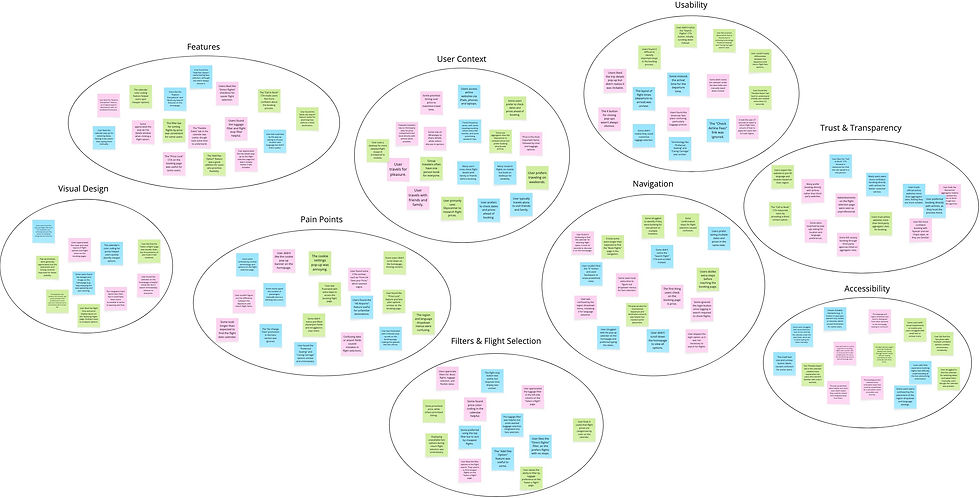
Affinity Mapping
Findings gathered during usability testing were organized through affinity mapping to identify recurring behavioral patterns, usability issues and decision-making friction points across the booking experience.
The analysis grouped observations into key categories including:
-
Usability
-
Navigation
-
Accessibility
-
Trust & transparency
-
Filters & flight selection
-
User context
-
Pain points
-
Visual design
This process helped transform isolated usability observations into broader behavioral insights that later informed the customer journey map, booking flow architecture and interaction prototype.
The affinity mapping phase also helped identify how pricing clarity, booking progression and navigation consistency directly influence user confidence throughout multi-step booking experiences.
Customer Journey Mapping
The booking journey was mapped to better understand how user goals, emotions and friction evolve throughout the booking process.
The analysis highlighted moments where uncertainty and cognitive friction increased significantly, particularly during:
-
Flight comparison
-
Fare selection
-
Extra service decisions
-
Final booking confirmation
The journey map also revealed how users frequently compare travel options collaboratively and seek reassurance before completing a purchase.
These insights helped define progression logic, booking stage separation and interaction priorities throughout the experience.

Booking Flow Architecture
A step-based flow architecture was created to organise the booking process into predictable stages with clear progression paths.
The flow separates:
-
Flight search
-
Departure and return selection
-
Trip confirmation
-
Passenger details
-
Extra services
-
Payment
This structure aimed to reduce uncertainty, support round-trip comparison and allow users to modify previous choices without restarting the process.

Interaction Design Exploration
Interaction mapping was used to explore navigation patterns, booking progression and decision-making behaviors before moving into visual UI development.
The exploration focused on:
-
Step progression clarity
-
Flight comparison interactions
-
Fare selection behavior
-
Confirmation patterns
-
Reducing ambiguity throughout the booking process
The iterative interaction studies allowed structural adjustments early in the process before developing the interaction prototype.

Interaction Prototype
The project concluded with an interaction prototype covering the complete airline booking journey, including flight search, departure and return selection, trip confirmation, passenger details, extra services and payment stages.
The prototype focused on establishing the structural and interaction foundations of the booking experience before moving into final visual UI development.
Insights gathered during usability testing directly influenced how information was organized, how booking stages were structured and how users progressed throughout the journey.
Particular attention was given to:
-
Reducing uncertainty during fare selection
-
Maintaining orientation across multiple booking stages
-
Improving pricing visibility throughout the journey
-
Separating optional services from core booking actions
-
Supporting faster comparison and decision-making
The screens were intentionally developed in grayscale to prioritize hierarchy, readability and interaction clarity during the UX phase of the project.


Outcome
The project demonstrates how research-driven UX decisions can improve clarity within complex transactional experiences.
Usability testing and journey mapping revealed that users often experience uncertainty during fare comparison, pricing decisions and multi-step booking progression.
These insights directly informed the structure of the interaction prototype, helping create a booking experience that feels more predictable, readable and easier to navigate.
By focusing on progression clarity, information organization and reduced interaction friction, the project aimed to support more confident decision-making throughout the booking journey.